Going back to my first point, the problem with party games is that we usually tend to fall into a "cycle" with party games. We tend to keep on playing the same ones over and over again, and we don't put as much effort into looking for new party games as we do with euros. Many party games are usually relatively cheap, don't take up too much space, and are always great to add to collections. So lets take a look at some party games that you many or may not have heard of, and break the cycle of ending every game night with Cards Against Humanity.
Dixit (2008)

- Designer: Jean-Louis Roubira
- Players: 3 - 6
- Playing time : 30 Minutes
- BGG Page
Dixit is a game that will go well with the creative types in your group. The deck is made up of numerous cards with detailed, abstract and elegant artwork. Here's how the gameplay works. One player is referred to as the storyteller, they tell a story, say a phrase or even just a word or sound and play a card face down (one that my group tends to use is "unseen dangers") the rest of the players play a card that has a picture corresponding to it. Each player votes on what card they think the storyteller played. If everyone or nobody gets the storytellers card, they get no points. He has to play a card and tell a story that some of the players will get, but not all of them.


Some examples of Dixit Cards
There's numerous expansions that are not really needed (if you want more cards with different artwork, then you should get it, otherwise it's not too necessary). But this is a great one for any gamer to add to their collection.
It is also worth noting that there is a free app for this game. I haven't tried it out, but it might be worth getting to see how you and your group enjoy this before buying the physical game.
Spyfall (2014)

- Designer: Alexandr Ushan
- Players: 3 - 8
- Playing time : 15 Minutes
- BGG Page
Spyfall is probably one of my favorite party games of all time and one of the best hidden role games I've played. one player is the spy, and the rest are agents. All of them are in a location (Church, Submarine, Casino, Train, School, etc.) but only the agents know where they are; the spy does not know where they currently are. The players ask each other questions; the agents are asking questions to see which player is the spy, and the spy is asking questions to probe for information to determine where he is. The game ends when the players figure out who the spy is before the time runs out, or the spy reveal them self and says where they are.
The only major downside to this game is that it is currently in Russian (an English version of this game will be released fairly soon), but for now, you can play it on your phone or on your computer through these two websites;
http://spyfall.meteor.com/
http://spyfall.adrianocola.com/


The only major downside to this game is that it is currently in Russian (an English version of this game will be released fairly soon), but for now, you can play it on your phone or on your computer through these two websites;
http://spyfall.meteor.com/
http://spyfall.adrianocola.com/
Balderdash (Latest: Mattel Edition 2015)
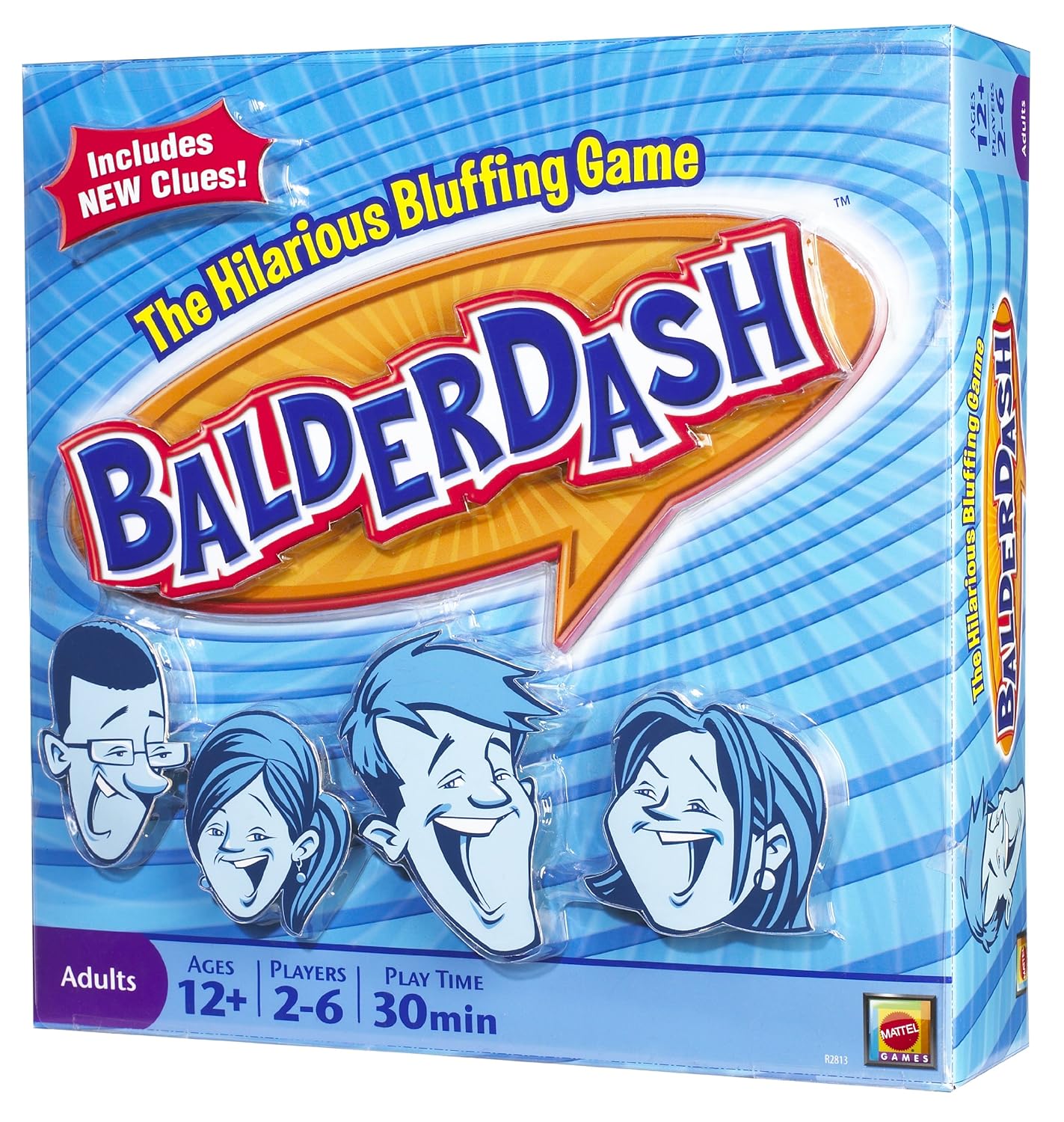
Balderdash may be a trivia game, but a good 99% of the time, you'll be bluffing. One player draws a card and rolls a die. The question is comes from 5 different categories;
- 1 corresponds to words; you have to give the definition of the word (ex. Pentapopemtic)
- 2 corresponds to a person; you have to say what their claim to fame was (ex. Lee Pockriss)
- 3 corresponds to an initial; you have to say what they stand for (ex, C,A,A,B)
- 4 corresponds a movie title; you have to give a brief synopsis about what the movie is about (ex. Three Nuts in Search of a Bolt).
- 5 corresponds to a silly law; you have to complete it (ex. In Los Angeles, California, it is illegal to bathe...)
- If you roll a 6, you get to choose which to category to use.
After being given the category and the item you must define, you have one of two options, bluff, or if by some miracle you know who A.J. Blatz is, you can write it down. Your goal is to have your bluff sound reasonable enough to get the other players to guess yours.
This is another great bluffing game that will appeal to your creative types in the group, and there are more than enough cards to worry about getting the same ones over and over again.
Concept (2013)
- Designer: Gaëtan Beaujannot
- Players: 4 -12
- Playing time : 40 Minutes
- BGG Link
The best way to describe this Pictionary, but you describe your word marking symbols on a board instead of drawing them.

The Board
Each card has 3 difficulty levels with 3 words each (Easy, Medium, Hard). My group has found that the easy difficulty was really easy, and some words on the hard could be really hard. Otherwise, I'd say this is a really fun game, and easy to learn. If you're playing with a family or with younger children, the easy level could help out a lot. Each time my gaming group has played it, we've always had fun.
Well that's it for today. I hope you enjoyed the first post of the blog. I have a few more party games I want to ta;lk about, but we'll save that for another day. Am I missing any other great party games? Comment and share some of your favorites.
